import tensorflow as tf
from tensorflow import keras
import matplotlib.pyplot as plt
import numpy as np
from tensorflow.keras.layers import Dense
from tensorflow.keras.models import SequentialBasic Deep Learning
Load dataset
The datset is the MINIST Digist dataset obtained from the Keras package.
# Load the MNIST Dataset
(x_train, y_train), (x_test, y_test) = keras.datasets.mnist.load_data()
Training and test set sizes
# Print training set size
n_samples_train = x_train.shape[0]
print(f"Training set size: {n_samples_train} images")

n_samples_test = x_test.shape[0]
# Print test set size
print(f"Test set size: {n_samples_test} images")
Training set size: 60000 images
Test set size: 10000 imagesData Preprocessing
# Reshape the data to flatten the images
x_train_flat = x_train.reshape((n_samples_train, -1))
x_test_flat = x_test.reshape((n_samples_test, -1))

# Normalise pixel values to be between 0 and 1
x_train_flat = x_train_flat / 255.0
x_test_flat = x_test_flat / 255.0

# One-hot encode the labels
y_train = keras.utils.to_categorical(y_train, num_classes=10)
y_test = keras.utils.to_categorical(y_test, num_classes=10)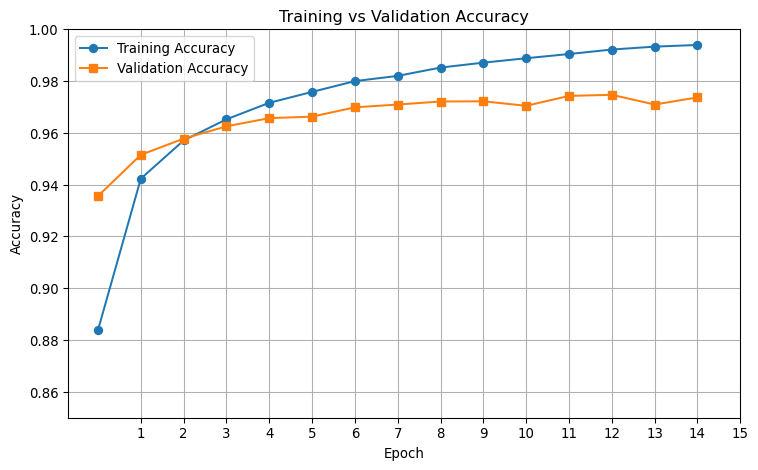
Key findings
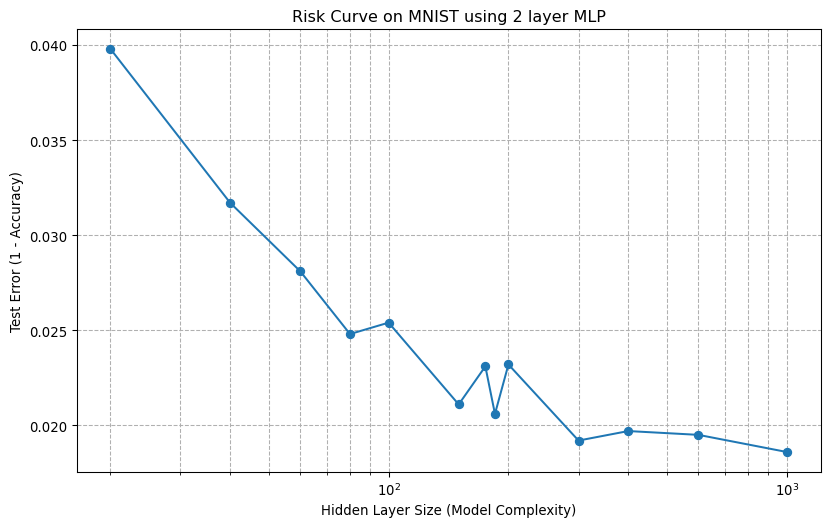
Generally, increasing the hidden layer size (Q4) improved accuracy, while increasing the number of hidden layers (Q3) beyond 2 layers did not. Performance generally improves with layer size but can degrade with excessive layers.
Double Descent Curve
# A wide range of hidden layer sizes to see the full curve
hidden_sizes = [20, 40, 60, 80, 100, 150, 175, 185, 200, 300, 400, 600, 1000]
test_errors = []

for size in hidden_sizes:
    print(f"Training a two-layer network with hidden layer size: {size}")

    # Create a two-layer network
    model = Sequential([
        Dense(size, activation="relu"),
        Dense(size, activation="relu"),
        Dense(10, activation="softmax")
    ])

    model.compile(
        optimizer="adam",
        loss="categorical_crossentropy",
        metrics=["accuracy"]
    )

    model.fit(x_train_flat, y_train, epochs=20, batch_size=128, verbose=0,
              validation_split=0.2)

    # Evaluate and store the test error (1 - accuracy)
    loss, accuracy = model.evaluate(x_test_flat, y_test, verbose=0)
    test_errors.append(1 - accuracy)
Training a two-layer network with hidden layer size: 20
Training a two-layer network with hidden layer size: 40
Training a two-layer network with hidden layer size: 60
Training a two-layer network with hidden layer size: 80
Training a two-layer network with hidden layer size: 100
Training a two-layer network with hidden layer size: 150
Training a two-layer network with hidden layer size: 175
Training a two-layer network with hidden layer size: 185
Training a two-layer network with hidden layer size: 200
Training a two-layer network with hidden layer size: 300
Training a two-layer network with hidden layer size: 400
Training a two-layer network with hidden layer size: 600
Training a two-layer network with hidden layer size: 1000# Plotting the result
plt.figure(figsize=(10, 6))
plt.plot(hidden_sizes, test_errors, marker="o", linestyle="-")
plt.xscale("log")
plt.title("Risk Curve on MNIST using 2 layer MLP")
plt.xlabel("Hidden Layer Size (Model Complexity)")
plt.ylabel("Test Error (1 - Accuracy)")
plt.grid(True, which="both", ls="--")
plt.show()